Integrated temperature control system集成温控系统
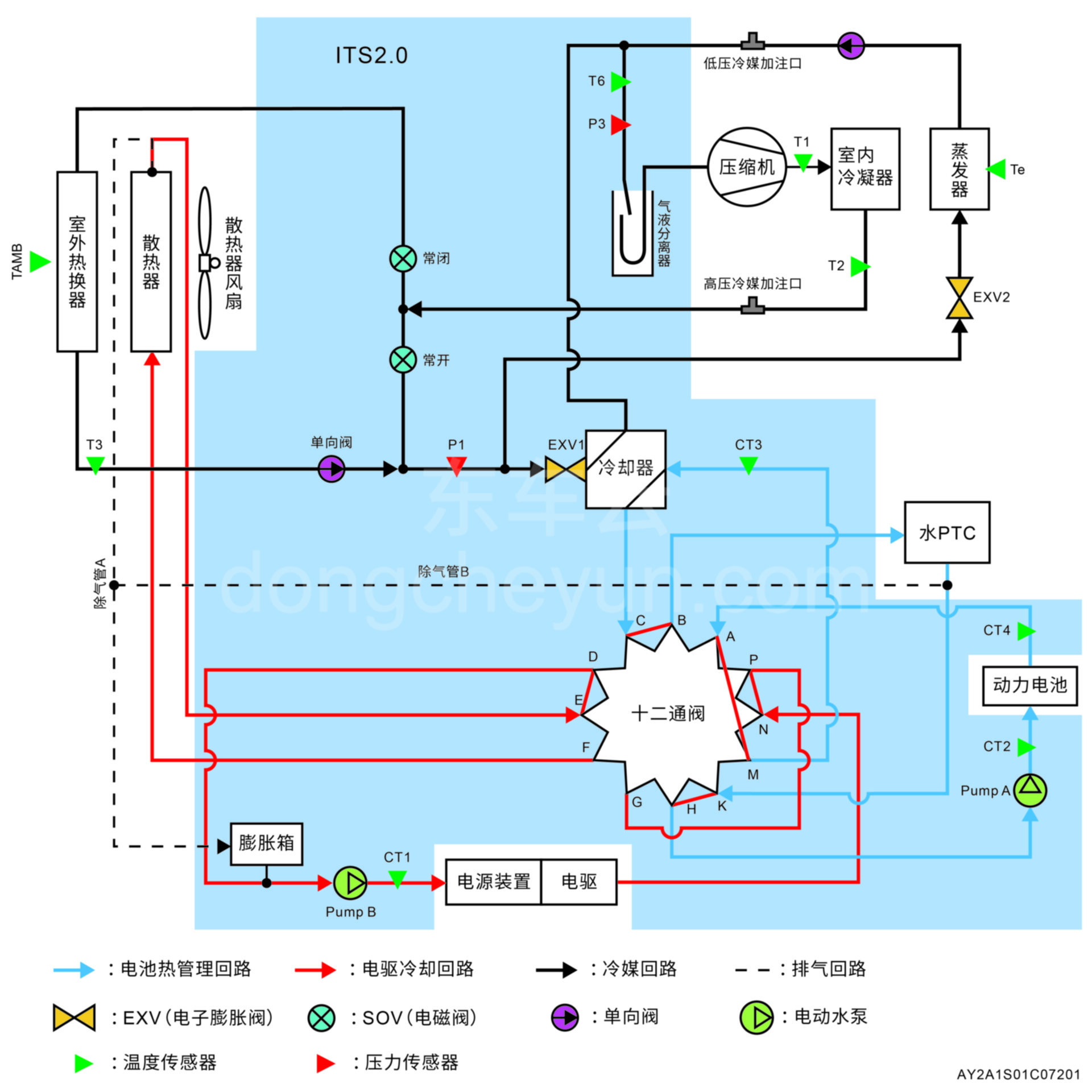
The system integrates components such as battery water pump, motor water pump, electric multi-way valve, water temperature sensor, electronic expansion valve, solenoid valve, PT sensor, P sensor and water tank, which can meet the adjustment of thermal management needs of vehicle batteries, motors, power supplies, etc.系统集成电池水泵、电机水泵、电动多通阀、水温传感器、电子膨胀阀、电磁阀、PT传感器、P传感器及水箱等部件,可以满足整车电池、电机、电源等热管理需求的调节
Schematic diagram原理图
|
1. |
The vehicle is equipped with an integrated modular cooling system, including cooling and heating of the high-voltage battery, electric drive assembly and power system (charger and DCDC).车辆装备有一个集成模块的冷却系统,包括对动力电池冷却与加热、电驱动总成及电源系统(充电机与DCDC)的冷却。 |
|
2. |
The entire cooling system uses 1 compressor, 1 MT (medium temperature) radiator, 1 12-volt radiator fan, and 1 cooling system integrated module (integrating 2 12-volt coolant pumps, 1 refrigerant/coolant heat exchanger, 1 electronic expansion valve, and 1 multi-way water valve) to cool the high-voltage battery, electric drive assembly and power system. At the same time, there is also a high-voltage coolant heater (PTC) in the circuit to heat the coolant entering the battery when needed. The thermal management control module (ITS) monitors the loop coolant temperature and ambient temperature. The battery management system (BMS) determines the required degree of battery cooling and heating and requests the ITS to initiate cooling or heating. The electric drive unit (DCU) and power supply system (IPS) determine the degree of cooling required. ITS turns on the coolant pump, controls the radiator fan as needed, turns on the high-pressure air conditioning compressor, and controls the opening of the electronic expansion valve.整个冷却系统使用1个压缩机,1个MT(中温)散热器,1个12伏散热器风扇, 1个冷却系统集成模块(集成2个12伏冷却液泵,1个制冷剂/冷却液热交换器,1个电子膨胀阀,1个多通水阀),以冷却高压蓄电池、电驱动总成及电源系统。同时,回路里还具有一个高压液体加热器,用于在需要时加热进入蓄电池的冷却液。热管理控制模块 (ITS) 监测回路冷却液温度及环境温度。电池管理系统(BMS)确定所需的蓄电池冷却和加热程度,并请求ITS启动冷却或加热。电驱动总成(DCU)及电源系统(IPS) 确定所需的冷却程度。ITS打开冷却液泵,并根据需要控制散热器风扇,和打开高压空调压缩机,并控制电子膨胀阀开度。 |
|
3. |
The entire cooling system circulates a pre-mixed coolant that isolates high voltages and prevents corrosion from affecting the performance of the heat sink. Always use premixed coolant in the cooling system, never tap water.整个冷却系统循环一种预混合的冷却液,此冷却液可隔离高电压并防止腐蚀影响散热片的性能。始终在冷却系统中使用预混合的冷却液,切勿使用自来水。 |
Battery Thermal Management电池热管理
|
1. |
The high-voltage battery thermal management functions are divided into: battery cooling, battery heating, and battery insulation functions.动力电池热管理功能分为:电池冷却、电池加热、电池保温功能。 |
|
2. |
There are two cooling methods for battery cooling: cooling mode through the front radiator and cooling mode through the battery cooler chiller.电池冷却有两种冷却方式:通过前端散热器进行冷却模式和通过电池冷却器chiller进行冷却模式。
| 1 |
|
Cooling mode through the battery cooler chiller: When the outdoor temperature is high, or the vehicle operating conditions are severe (such as rapid acceleration, rapid deceleration, long-term high-load driving, etc.), resulting in a high temperature of the high-voltage battery, the battery temperature control system automatically enters the cooling mode through the battery cooler chiller. At this time, the electric compressor will automatically turn on, using the refrigerant medium to cool the battery circuit coolant, thereby cooling the high-voltage battery.通过电池冷却器chiller进行冷却模式:当室外温度高,或者车辆工况恶劣(如急加速、急减速、长时间高负荷行驶等),致使动力电池温度较高时,电池温控系统自动进入通过电池冷却器chiller进行冷却模式,此时电动压缩机会自动开启,利用冷媒介质对电池回路冷却液进行冷却,从而冷却动力电池。 |
| 2 |
|
Cooling mode through front-end radiator: When the outdoor temperature is low or very low, and the high-voltage battery temperature is high and needs cooling, the battery temperature control system automatically enters the cooling mode through the front-end radiator. At this time, the battery circuit coolant flows through the front-end radiator, and the battery circuit coolant is cooled through the front-end radiator, thereby cooling the high-voltage battery.通过前端散热器进行冷却模式:当室外温度较低或者很低时,动力电池温度较高需要冷却时,电池温控系统自动进入通过前端散热器进行冷却模式,此时电池回路冷却液流经前端散热器,通过前端散热器对电池回路冷却液进行降温,从而冷却动力电池。 |
|
|
3. |
Battery heating function: In low-temperature environments, when the high-voltage battery temperature is low, the high-voltage battery heating function will automatically turn on. At this time, the coolant in the battery circuit is heated by the high-voltage heater or the waste heat of the electric drive, thereby heating the high-voltage battery.电池加热功能:低温环境下,动力电池温度较低时,动力电池加热功能会自动开启,此时通过高压加热器或电驱余热加热电池回路的冷却液,从而加热动力电池。
| 1 |
|
Charging and heating: When the high-voltage battery temperature is low when charging, the high-voltage battery will turn on the heating function. During the charging process, the electric drive has basically no waste heat to utilize, so it is generally heated by a high-voltage heater. Since the heater consumes part of the power when it is turned on, the charging time at this time is slightly longer than that at normal temperature.充电加热:动力电池温度较低时充电,动力电池会开启加热功能,充电过程中电驱基本无余热可以利用,因此一般通过高压加热器加热。由于加热器开启时会消耗一部分电量,此时充电时间较常温下充电时间稍长。 |
|
|
4. |
High-voltage battery insulation function: When the vehicle is parked outdoors for a long time at a low temperature for AC charging, in order to prevent the high-voltage battery temperature from being too low and affecting its performance, after the AC charging is completed, the heater will be automatically turned on to keep the high-voltage battery warm.动力电池保温功能:当车辆长时间停在温度较低的室外慢充时,为避免动力电池温度过低,影响其性能,慢充结束后,将自动开启加热器对动力电池进行保温。 |
Electric drive thermal management电驱热管理
|
1. |
During the driving and energy recovery process of electric drive components, the IPS, motor controller and drive motor will all generate heat losses. Effective cooling media and cooling methods are required to take away the heat and ensure that the electric drive components operate safely and reliably in a reasonable thermal environment.电驱部件在驱动和回收能量的工作过程中,IPS、电机控制器和驱动电机都会产生热损耗,需要有效的冷却介质和冷却方式来带走热量,保证电驱部件在一个合理的热环境中安全可靠运行。 |
|
2. |
The cooling system mainly relies on the cooling water pump to drive the coolant to circulate in the cooling pipe. Through the front-end cooling module, the coolant takes away the heat generated by the electric drive components. In order to fully dissipate heat, a fan is also installed behind the radiator to increase the air intake volume of the front-end cooling module, thereby enhancing the system cooling capacity.冷却系统主要依靠冷却水泵带动冷却液在冷却管道中循环流动,通过前端冷却模块,冷却液带走电驱部件产生的热量。为了充分散热,还在散热器后方设置风扇,用于增大前端冷却模块的进风量,进而增强系统冷却能力。 |
electronic fan电子风扇
Schematic diagram原理图
|
1. |
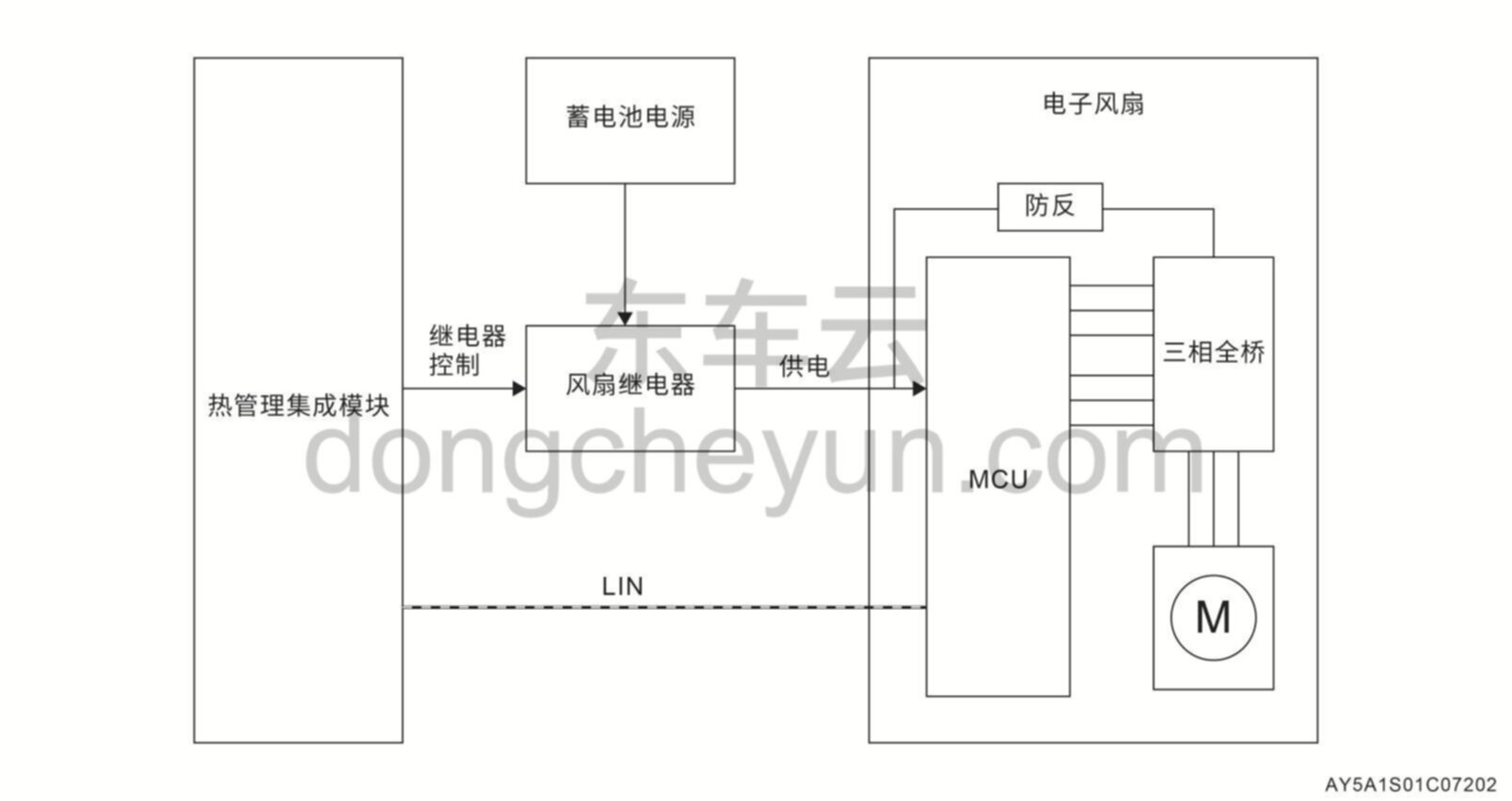
The electronic fan is used to increase the air flow rate through the radiator, enhance the heat dissipation effect, and accelerate the cooling of the coolant.电子风扇是用来提高通过散热器的空气流速,增强散热的效果,加速冷却液的冷却。 |
|
2. |
When the working conditions of the electronic fan are met, the thermal management integrated module controls the fan relay to close and the 12V battery supplies power to the electronic fan; at the same time, the thermal management integrated module controls the operating status of the electronic fan through different control signals on the LIN line.当满足电子风扇工作条件时,热管理集成模块控制风扇继电器闭合,蓄电池向电子风扇供电;与此同时,热管理集成模块通过LIN线不同的控制信号,控制电子风扇的运行状态。 |
 System description系统说明