Tire rotation
Text of these pages
Page 200
CAUTION :
◆ The driving speed should not exceed 80km/h after the tire is repaired with the tire sealer.
◆ The tire sealer is only used for a temporary repair. Please contact a GAC Service Center soon afterward for tire repair or replacement.
◆ The tire sealer bottle should not be placed upside down.
Tire rotation
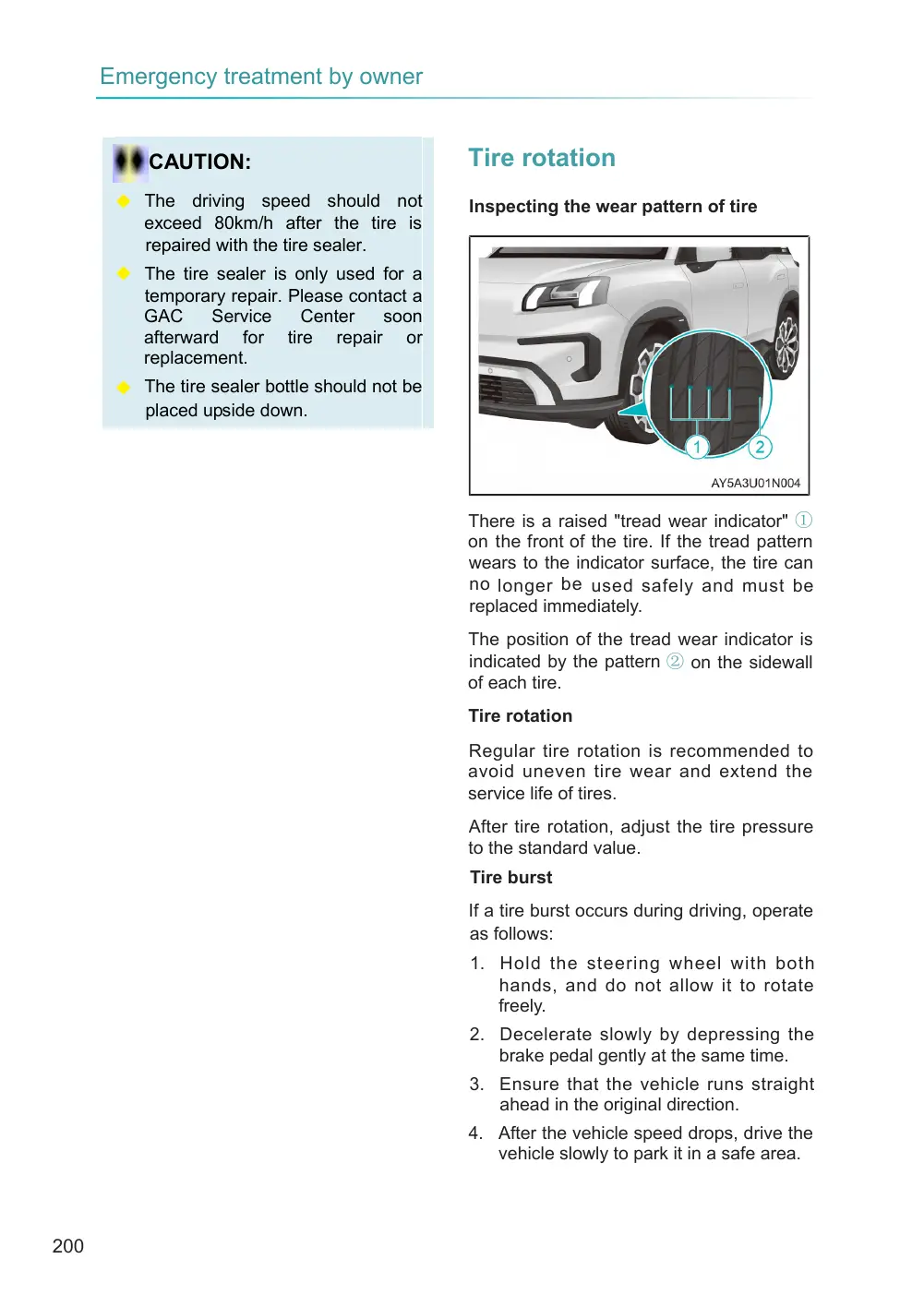
Inspecting the wear pattern of tire
There is a raised "tread wear indicator" ① on the front of the tire. If the tread pattern wears to the indicator surface, the tire can no longer be used safely and must be replaced immediately.
The position of the tread wear indicator is indicated by the pattern ② on the sidewall of each tire.
Tire rotation
Regular tire rotation is recommended to avoid uneven tire wear and extend the service life of tires.
After tire rotation, adjust the tire pressure to the standard value.
Tire burst
If a tire burst occurs during driving, operate as follows:
1. Hold the steering wheel with both hands, and do not allow it to rotate freely.
2. Decelerate slowly by depressing the brake pedal gently at the same time.
3. Ensure that the vehicle runs straight ahead in the original direction.
4. After the vehicle speed drops, drive the vehicle slowly to park it in a safe area.
Page 201
5. Replace the tire or make a rescue call as needed.
WARNING
◆ Do not depress the brake pedal sharply; otherwise, the vehicle may lose balance and thus turn over. ◆ Turn on the hazard warning lamp timely, and place a warning triangle behind the vehicle as specified to avoid secondary accidents.
NOTE
◆ For tire position change or rotation, it is suggested you contact the GAC Service Center.
Spare tire
The spare tire is located in the trunk. The spare tire shall not be removed before the trunk carpet and driver’s tools are removed.
Unscrew the spare tire fixing handwheel in the direction of the arrow shown in the figure, and take out the spare tire.
CAUTION
◆ Check the pressure of the spare tire regularly to ensure that it is at the standard value. ◆ Check the spare tire regularly, and do not use a damaged spare tire.
◆ Check whether the tire pressure is at the standard value after the spare tire is installed.
◆ Do not place the oil and spare tire together to avoid corrosion of the spare tire due to oil leakage, which will reduce the service life of the spare tire.
◆ It is recommended to replace a spare tire that has been used for more than 4 years.
NOTE :
◆ When driving a vehicle equipped with spare tires, do not perform the following operations:
Drive at a maximum speed of more than 80km/h.
The vehicle load exceeds the gross vehicle weight rating.
Tow a tow truck.
Use tire chains on one end of a vehicle equipped with spare tires.
Use multiple spare tires at once.
Use commercial equipment.
wash
car
Try repairing spare tires.
Spare tires can only be used temporarily for emergency. In this case, the maximum driving speed shall not exceed 80 km/h, the traveled distance shall not exceed 50 km, and sharp acceleration and emergency braking shall be avoided.
A damaged spare tire should be replaced rather than repaired.
The vehicle is equipped with non- full-size spare tires.
Replacing tires
Preparations:
◇ Park the vehicle in a hard, flat and safe place.
◇ Shift to "P" position to enable the parking brake. ◇ Turn on the hazard warning lamp.
◇ Make sure that all occupants get out of the vehicle and wait in a safe place.
Page 202
◇ Switch off the vehicle power supply. ◇ Place a warning triangle behind the vehicle as specified according to the actual situation. ◇ Place a stopper in front of tire in the diagonal direction of the flat tire to prevent the vehicle from sliding.
◇ Take out the driver’s tools such as the jack and wheel bolt wrench.
◇ Take out the spare tire.
Remove a damaged tire in the following steps:
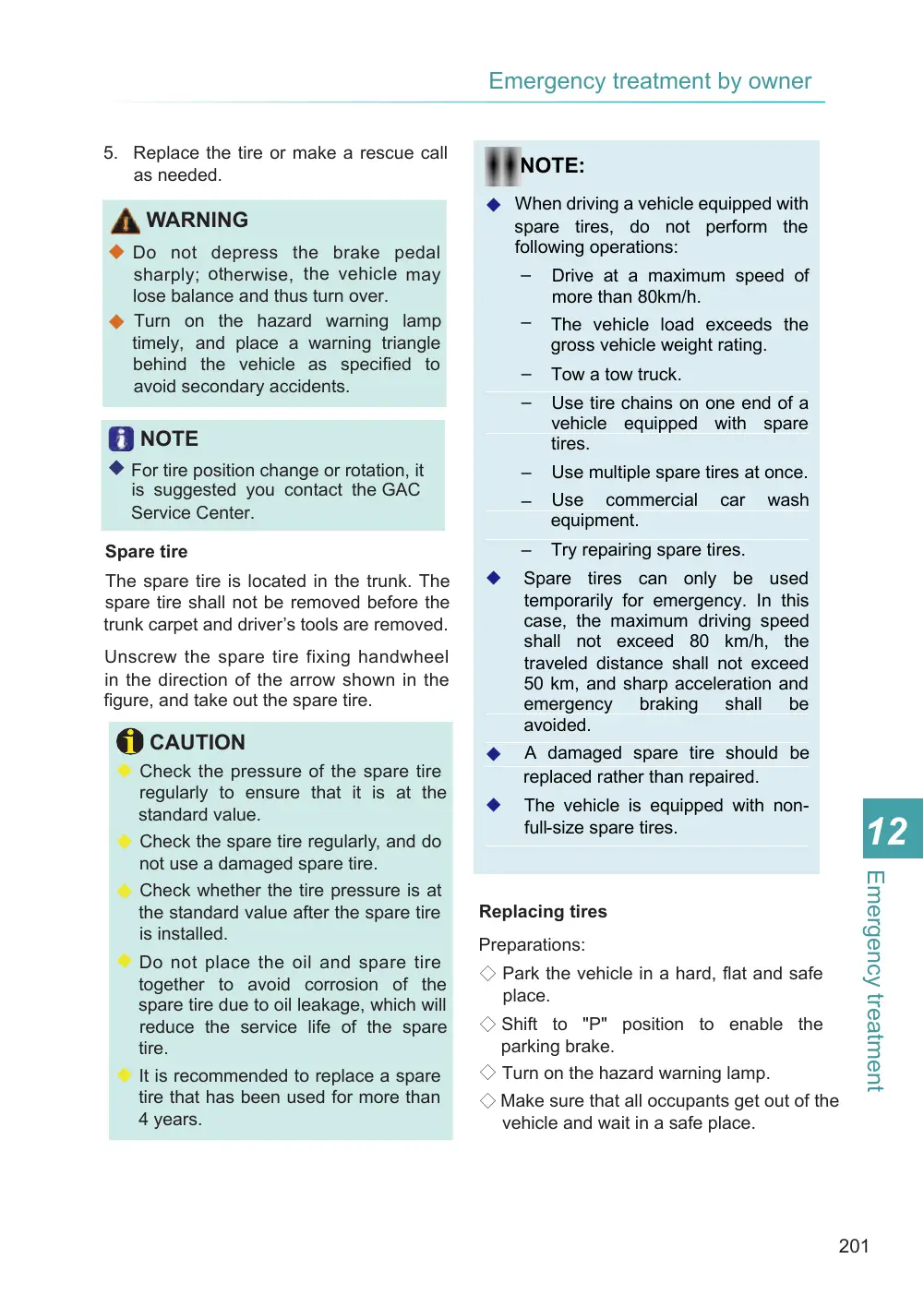
Turn the wheel bolts counterclockwise with the wheel bolt wrench, to loosen them by 1~2 turns.
1.
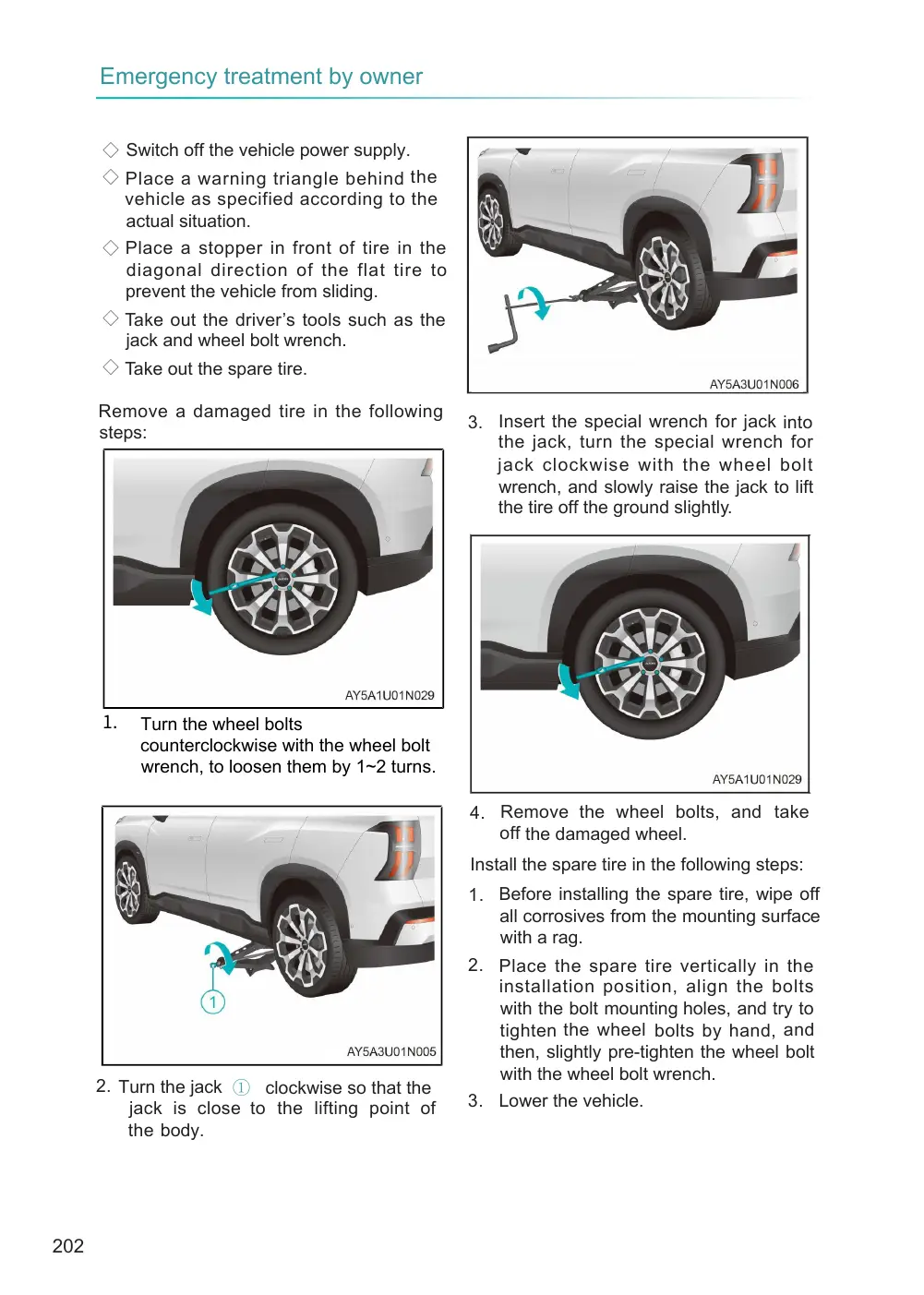
2. Turn the jack ① clockwise so that the jack is close to the lifting point of the body.
3. Insert the special wrench for jack into the jack, turn the special wrench for jack clockwise with the wheel bolt wrench, and slowly raise the jack to lift the tire off the ground slightly.
4. Remove the wheel bolts, and take off the damaged wheel.
Install the spare tire in the following steps:
1. Before installing the spare tire, wipe off all corrosives from the mounting surface with a rag.
2. Place the spare tire vertically in the installation position, align the bolts with the bolt mounting holes, and try to tighten the wheel bolts by hand, and then, slightly pre-tighten the wheel bolt with the wheel bolt wrench. 3. Lower the vehicle.
Page 203
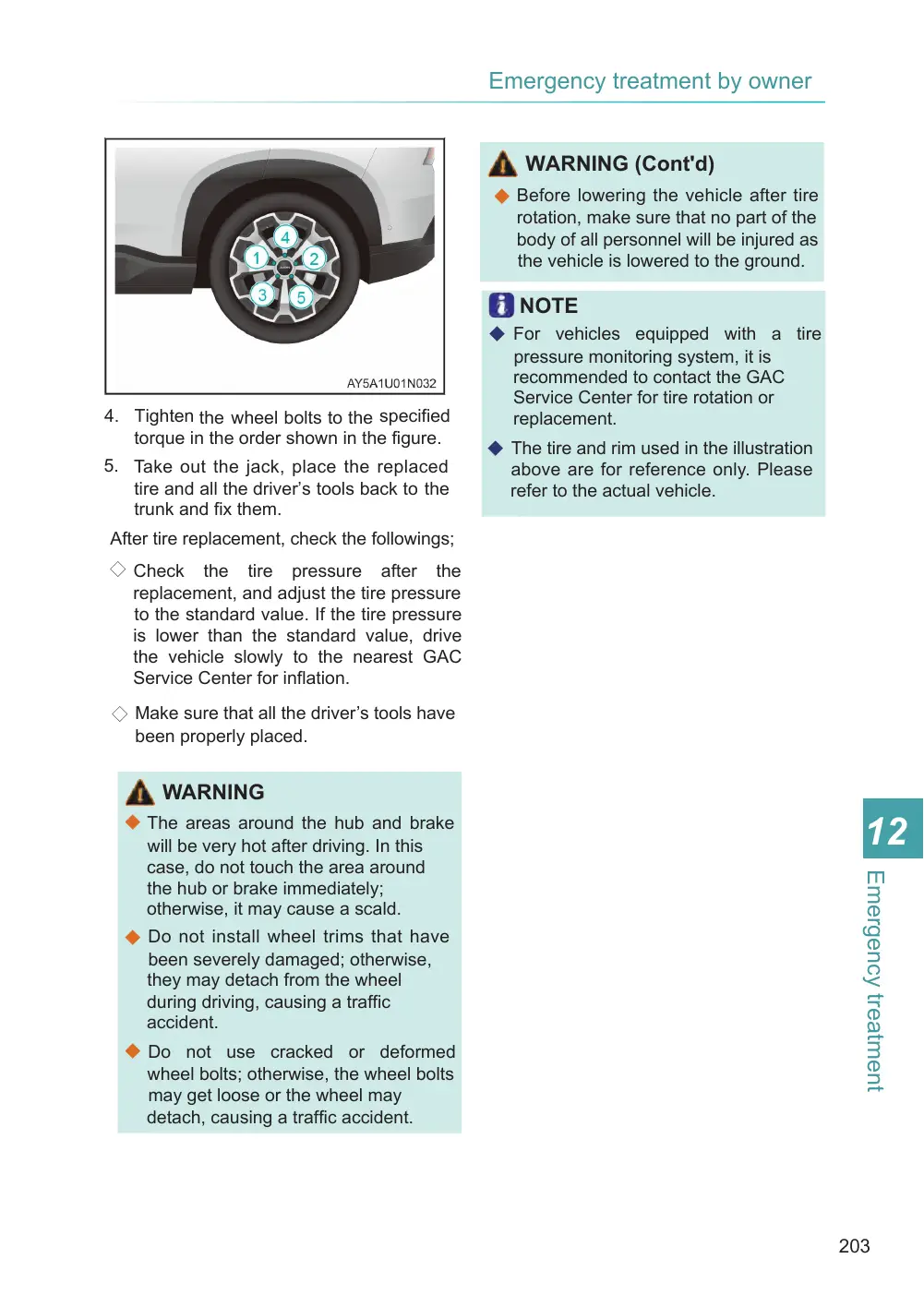
4. Tighten the wheel bolts to the specified torque in the order shown in the figure.
5. Take out the jack, place the replaced tire and all the driver’s tools back to the trunk and fix them.
After tire replacement, check the followings;
◇ Check the tire pressure after the replacement, and adjust the tire pressure to the standard value. If the tire pressure is lower than the standard value, drive the vehicle slowly to the nearest GAC Service Center for inflation.
◇ Make sure that all the driver’s tools have been properly placed.
WARNING
◆ The areas around the hub and brake will be very hot after driving. In this case, do not touch the area around the hub or brake immediately; otherwise, it may cause a scald.
◆ Do not install wheel trims that have been severely damaged; otherwise, they may detach from the wheel during driving, causing a traffic accident.
◆ Do not use cracked or deformed wheel bolts; otherwise, the wheel bolts may get loose or the wheel may detach, causing a traffic accident.
WARNING (Cont'd)
◆ Before lowering the vehicle after tire rotation, make sure that no part of the body of all personnel will be injured as the vehicle is lowered to the ground.
NOTE
◆ For vehicles equipped with a tire pressure monitoring system, it is recommended to contact the GAC Service Center for tire rotation or replacement.
◆ The tire and rim used in the illustration above are for reference only. Please refer to the actual vehicle.