Tire repair
Text of these pages
Page 197
6.
Screw off the connector of the air pump and mount the tire valve cap.
Unplug the power plug, properly store the air pump.
and
7.
Tire repair
Tire leakage
There may not always be an obvious leakage if a tire is punctured by a sharp object. If a leakage is found, reduce speed gradually by depressing the brake pedal gently, keep driving straight, and park the vehicle in a safe area away from heavy traffic. Repair or replace the tire upon parking as needed.
WARNIN G
◆ When repairing or replacing a tire, turn on the hazard warning lamp and place a warning triangle behind the vehicle as stipulated to avoid a secondary accident.
◆ Do not keep driving with a flat tire, because the tire may be damaged beyond repair even for a small distance.
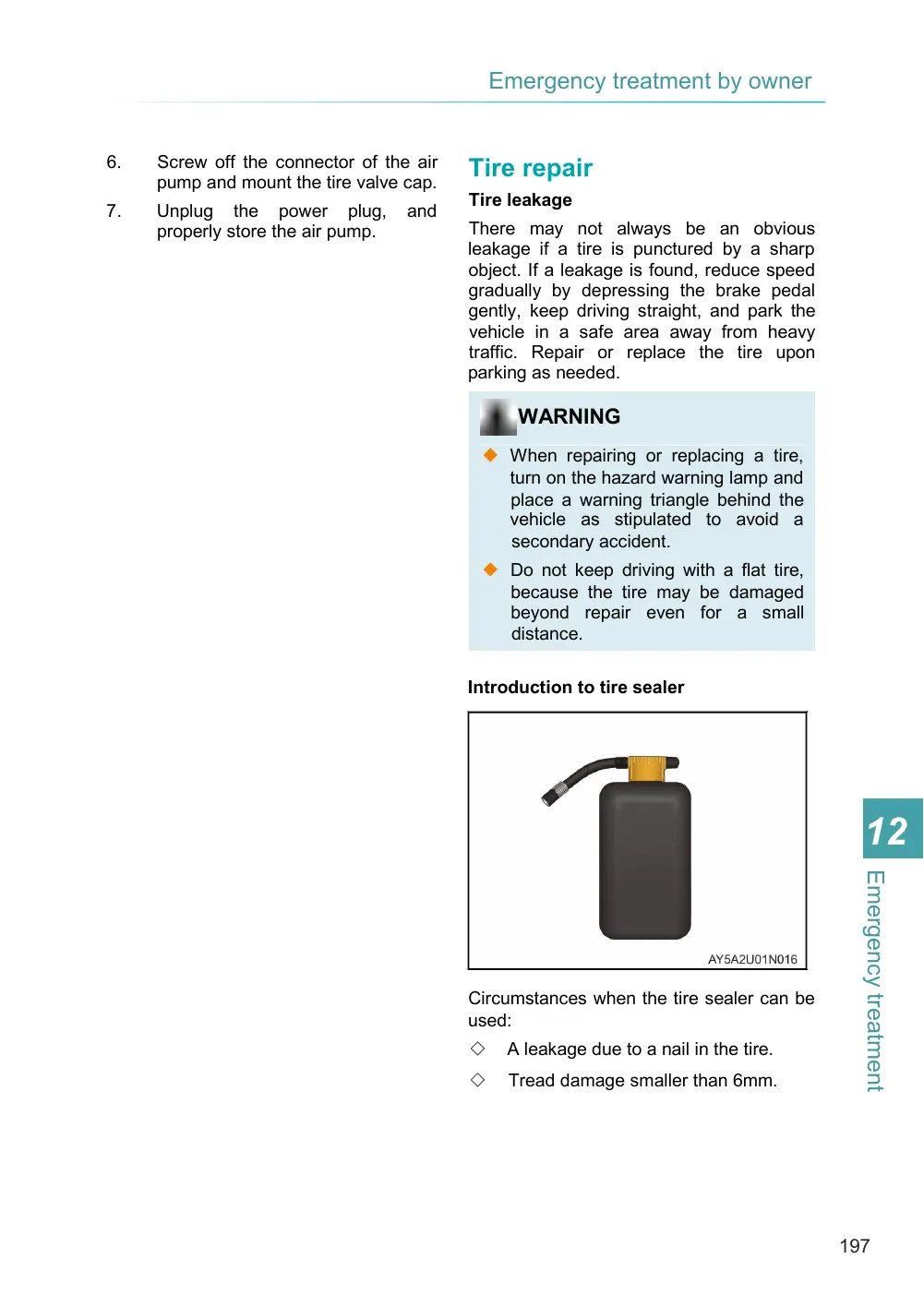
Introduction to tire sealer
Circumstances when the tire sealer can be used:
A leakage due to a nail in the tire.
Tread damage smaller than 6mm.
Page 198
Circumstances when the tire sealer should not be used:
A tire burst.
Tire sidewall damage.
A puncture by a sharp object that is 6mm or bigger.
An exposed hub.
A damaged hub.
Nails in more than one tire.
WARNIN G
1.
◆ Inhalation of the tire sealer may damage your health. If it is swallowed accidentally, get medical help right away.
◆ If the tire sealer gets into the eyes or comes into contact with the skin, flush the contact area with plenty of water, and get medical help right away.
NOTE :
◆ The tire sealer can only be used once. You don't have to use it when the leakage is slow.
2.
◆ A bottle of tire sealer can only be used to repair one tire.
◆ The tire sealer has a five-year shelf life. Use it in the temperature range of -30°C to 70°C.
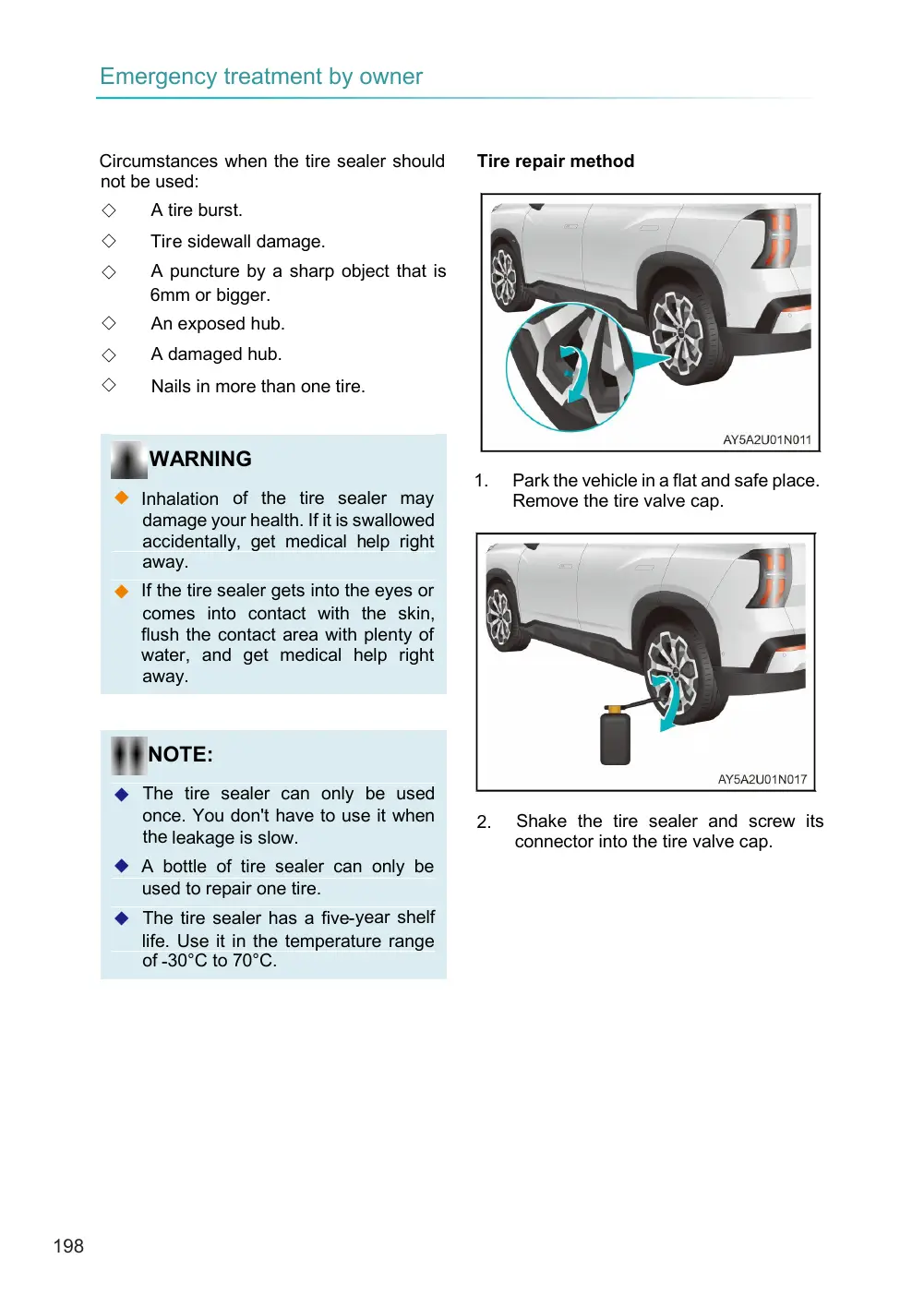
Tire repair method
Park the vehicle in a flat and safe place. Remove the tire valve cap.
Shake the tire sealer and screw its connector into the tire valve cap.
Page 199
6.
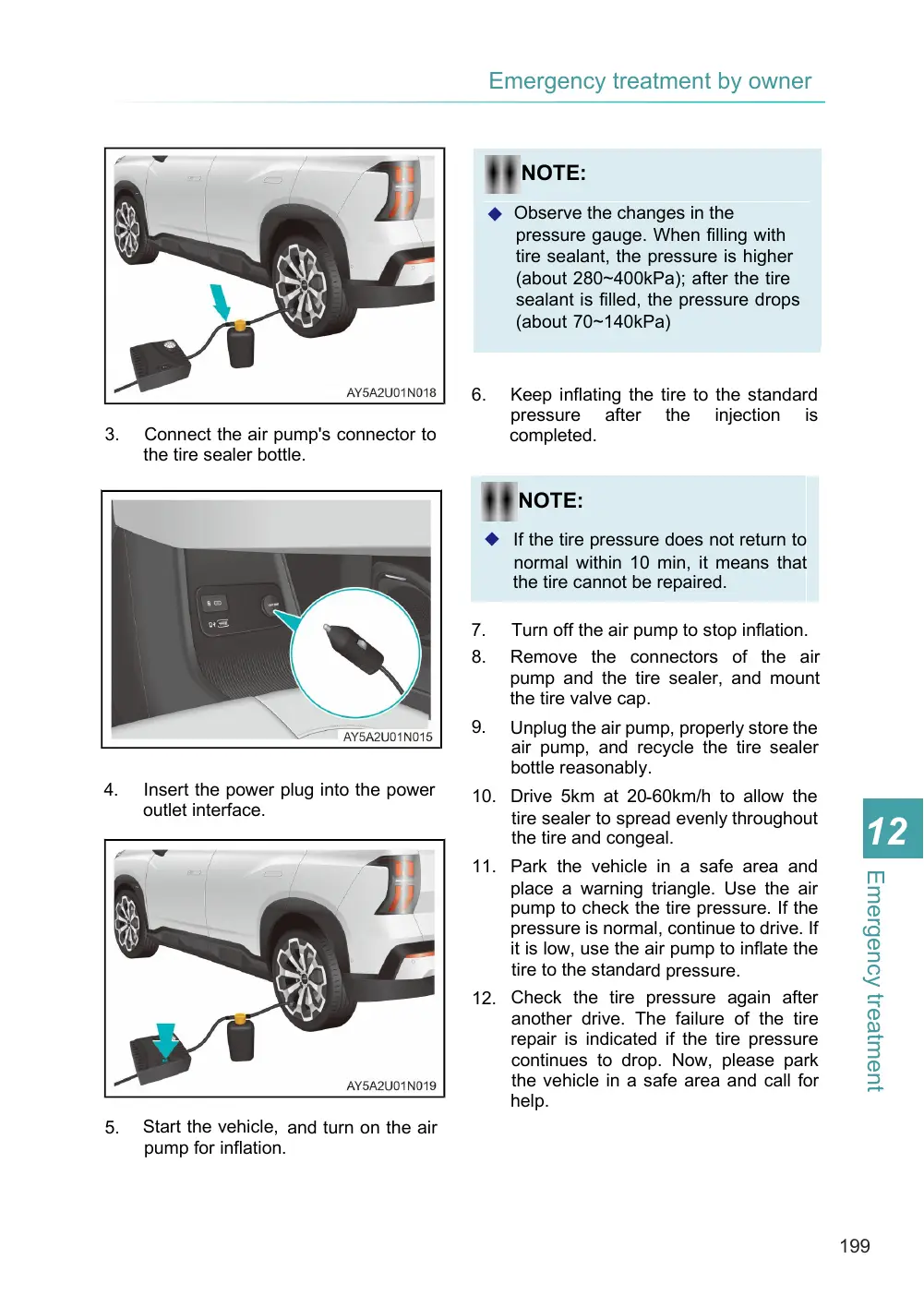
Connect the air pump's connector to the tire sealer bottle.
3.
7. 8.
9.
Insert the power plug into the power outlet interface.
4.
Start the vehicle, and turn on the air pump for inflation.
5.
NOTE :
◆ Observe the changes in the pressure gauge. When filling with tire sealant, the pressure is higher (about 280~400kPa); after the tire sealant is filled, the pressure drops (about 70~140kPa)
Keep inflating the tire to the standard pressure after the injection is completed.
NOTE :
◆ If the tire pressure does not return to normal within 10 min, it means that the tire cannot be repaired.
Turn off the air pump to stop inflation.
Remove the connectors of the air pump and the tire sealer, and mount the tire valve cap.
Unplug the air pump, properly store the air pump, and recycle the tire sealer bottle reasonably.
10. Drive 5km at 20-60km/h to allow the tire sealer to spread evenly throughout the tire and congeal.
11. Park the vehicle in a safe area and place a warning triangle. Use the air pump to check the tire pressure. If the pressure is normal, continue to drive. If it is low, use the air pump to inflate the tire to the standard pressure. 12. Check the tire pressure again after another drive. The failure of the tire repair is indicated if the tire pressure continues to drop. Now, please park the vehicle in a safe area and call for help.
Page 200
CAUTION :
◆ The driving speed should not exceed 80km/h after the tire is repaired with the tire sealer.
◆ The tire sealer is only used for a temporary repair. Please contact a GAC Service Center soon afterward for tire repair or replacement.
◆ The tire sealer bottle should not be placed upside down.
Tire rotation
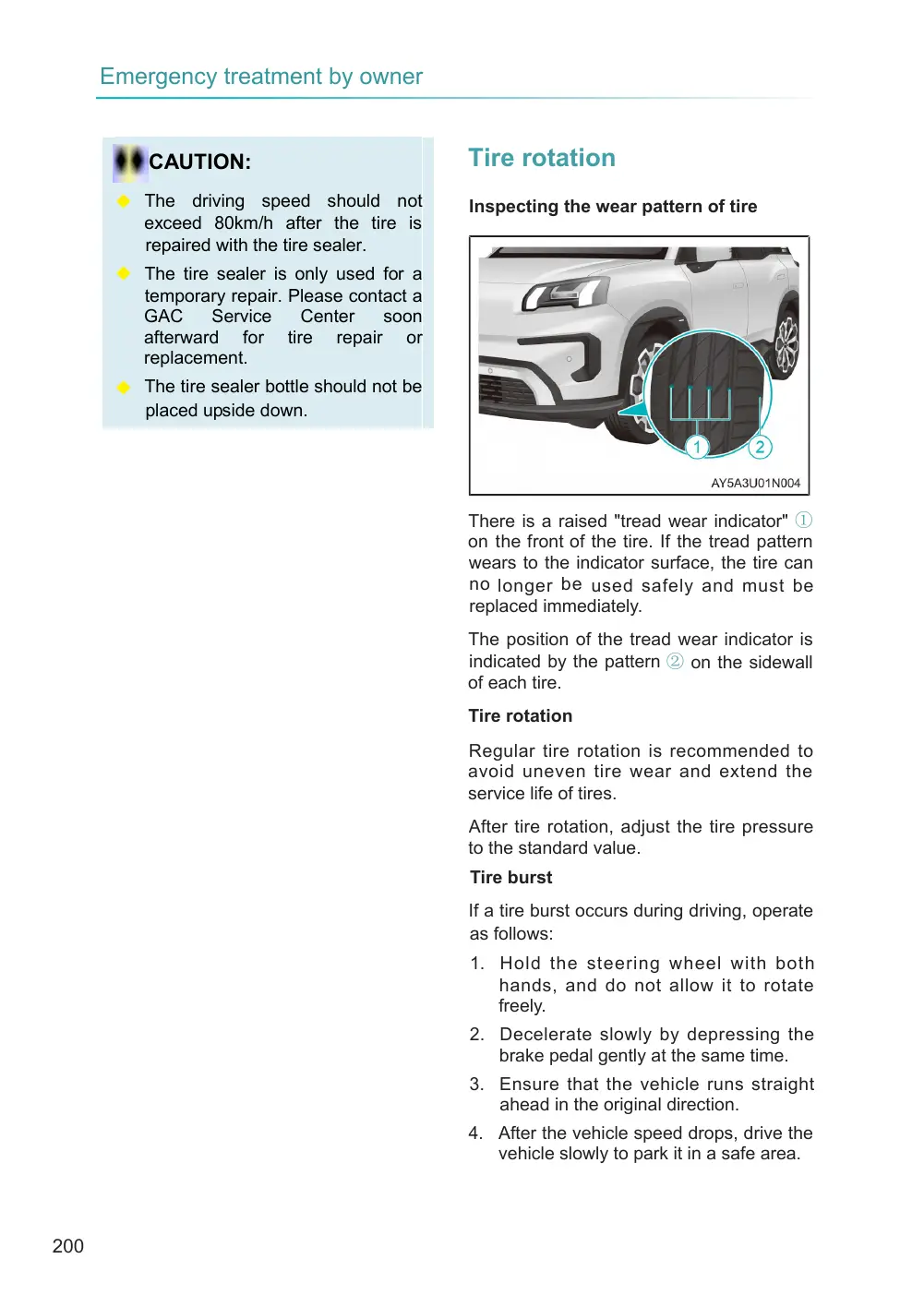
Inspecting the wear pattern of tire
There is a raised "tread wear indicator" ① on the front of the tire. If the tread pattern wears to the indicator surface, the tire can no longer be used safely and must be replaced immediately.
The position of the tread wear indicator is indicated by the pattern ② on the sidewall of each tire.
Tire rotation
Regular tire rotation is recommended to avoid uneven tire wear and extend the service life of tires.
After tire rotation, adjust the tire pressure to the standard value.
Tire burst
If a tire burst occurs during driving, operate as follows:
1. Hold the steering wheel with both hands, and do not allow it to rotate freely.
2. Decelerate slowly by depressing the brake pedal gently at the same time.
3. Ensure that the vehicle runs straight ahead in the original direction.
4. After the vehicle speed drops, drive the vehicle slowly to park it in a safe area.