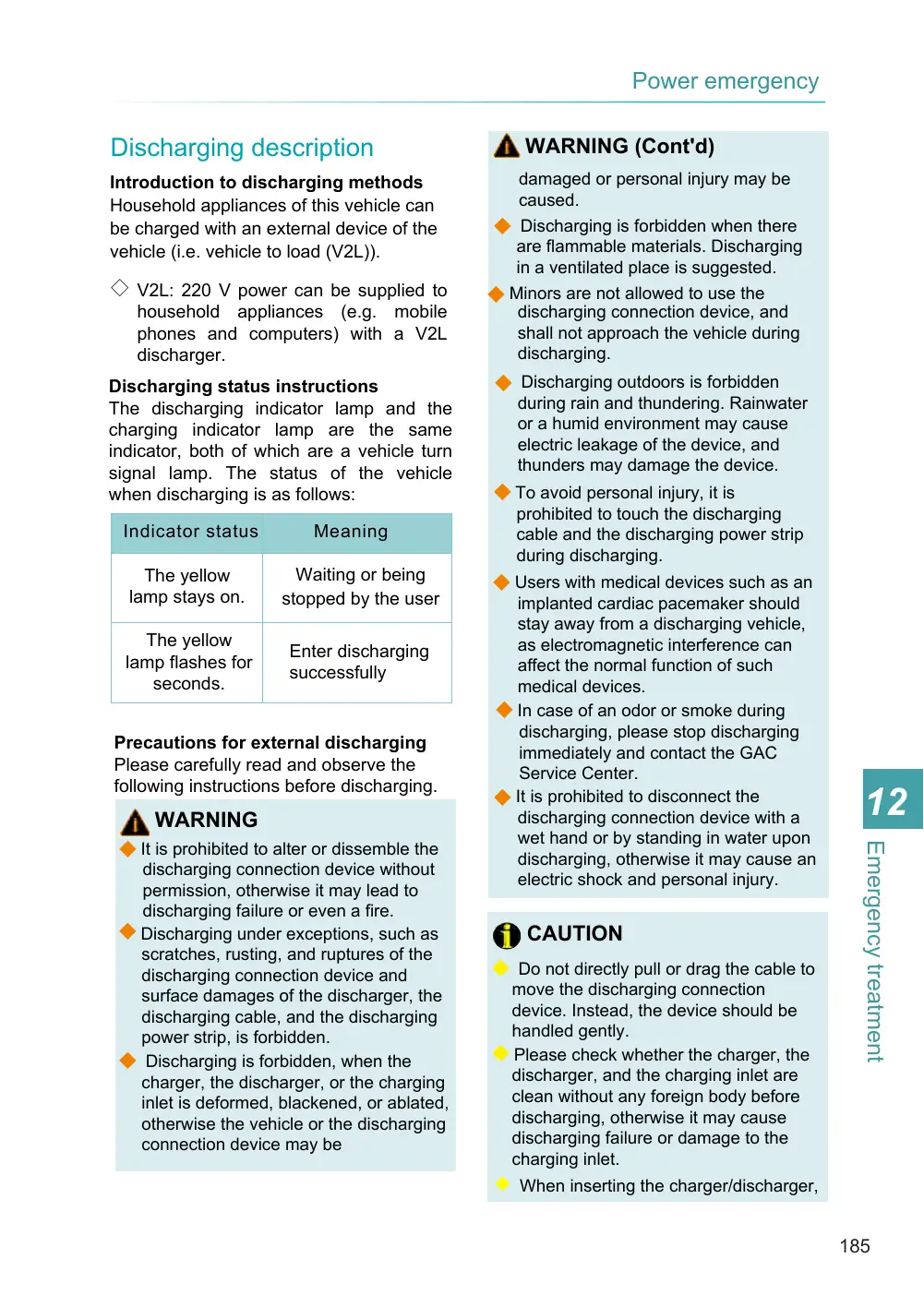
Discharging description
Text of these pages
Page 185
Discharging description
Introduction to discharging methods Household appliances of this vehicle can be charged with an external device of the vehicle (i.e. vehicle to load (V2L)).
◇ V2L: 220 V power can be supplied to household appliances (e.g. mobile phones and computers) with a V2L discharger.
Discharging status instructions The discharging indicator lamp and the charging indicator lamp are the same indicator, both of which are a vehicle turn signal lamp. The status of the vehicle when discharging is as follows:
Indicator status
Meaning
Waiting or being stopped by the user
The yellow lamp stays on.
The yellow lamp flashes for seconds.
Enter discharging successfully
Precautions for external discharging Please carefully read and observe the following instructions before discharging.
WARNING
◆ It is prohibited to alter or dissemble the discharging connection device without permission, otherwise it may lead to discharging failure or even a fire. ◆ Discharging under exceptions, such as scratches, rusting, and ruptures of the discharging connection device and surface damages of the discharger, the discharging cable, and the discharging power strip, is forbidden. ◆ Discharging is forbidden, when the charger, the discharger, or the charging inlet is deformed, blackened, or ablated, otherwise the vehicle or the discharging connection device may be
WARNING (Cont'd)
damaged or personal injury may be caused. ◆ Discharging is forbidden when there are flammable materials. Discharging in a ventilated place is suggested.
◆ Minors are not allowed to use the discharging connection device, and shall not approach the vehicle during discharging.
◆ Discharging outdoors is forbidden during rain and thundering. Rainwater or a humid environment may cause electric leakage of the device, and thunders may damage the device.
◆ To avoid personal injury, it is prohibited to touch the discharging cable and the discharging power strip during discharging.
◆ Users with medical devices such as an implanted cardiac pacemaker should stay away from a discharging vehicle, as electromagnetic interference can affect the normal function of such medical devices. ◆ In case of an odor or smoke during discharging, please stop discharging immediately and contact the GAC Service Center. ◆ It is prohibited to disconnect the discharging connection device with a wet hand or by standing in water upon discharging, otherwise it may cause an electric shock and personal injury.
CAUTION
◆ Do not directly pull or drag the cable to move the discharging connection device. Instead, the device should be handled gently. ◆ Please check whether the charger, the discharger, and the charging inlet are clean without any foreign body before discharging, otherwise it may cause discharging failure or damage to the charging inlet. ◆ When inserting the charger/discharger,
Page 186
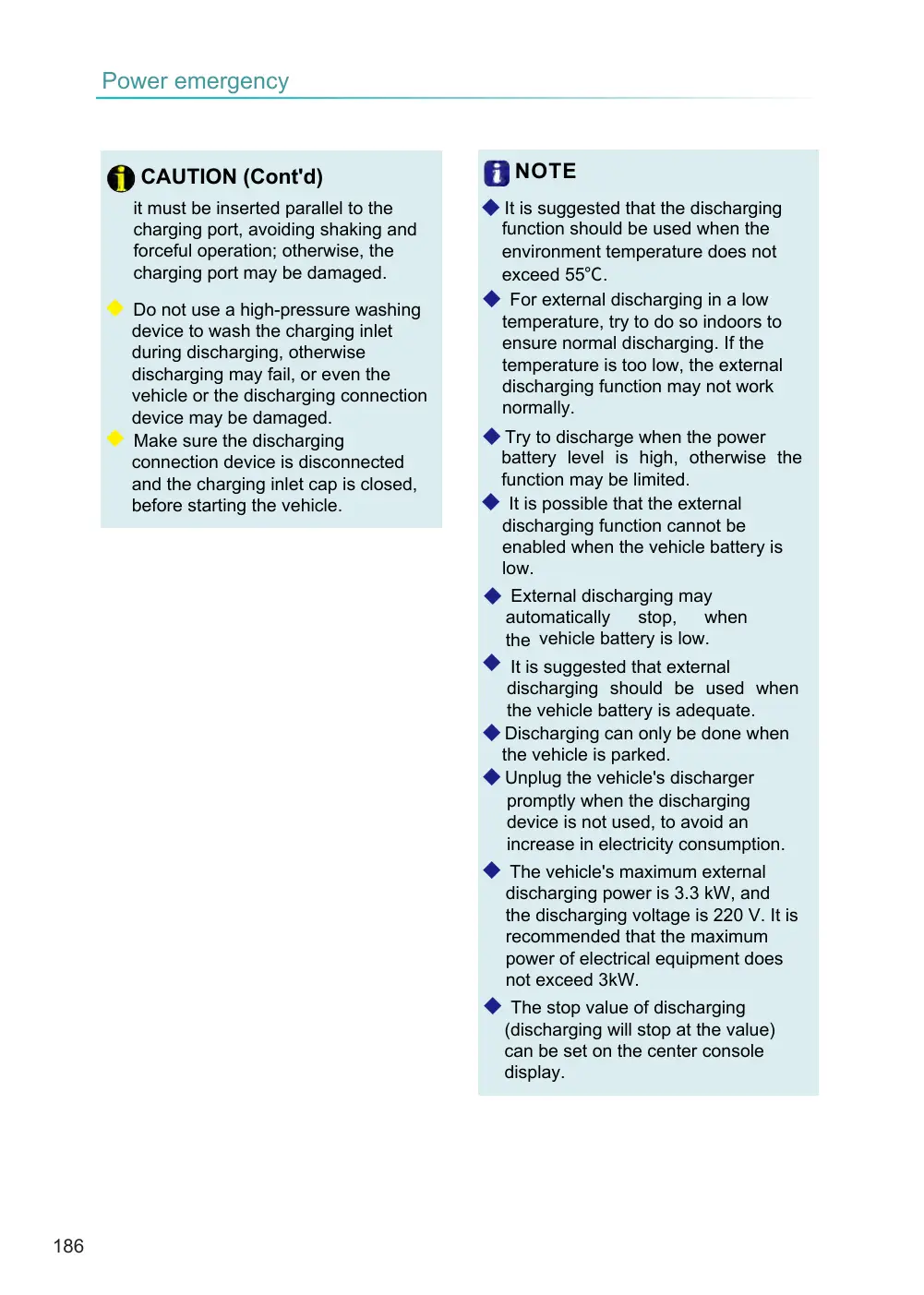
CAUTION (Cont'd)
it must be inserted parallel to the charging port, avoiding shaking and forceful operation; otherwise, the charging port may be damaged.
◆ Do not use a high-pressure washing device to wash the charging inlet during discharging, otherwise discharging may fail, or even the vehicle or the discharging connection device may be damaged. ◆ Make sure the discharging connection device is disconnected and the charging inlet cap is closed, before starting the vehicle.
NOTE
◆ It is suggested that the discharging function should be used when the environment temperature does not exceed 55℃. ◆ For external discharging in a low temperature, try to do so indoors to ensure normal discharging. If the temperature is too low, the external discharging function may not work normally.
◆ Try to discharge when the power battery level is high, otherwise the function may be limited. ◆ It is possible that the external discharging function cannot be enabled when the vehicle battery is low.
◆ External discharging may automatically stop, when the vehicle battery is low. ◆ It is suggested that external discharging should be used when the vehicle battery is adequate. ◆ Discharging can only be done when the vehicle is parked. ◆ Unplug the vehicle's discharger promptly when the discharging device is not used, to avoid an increase in electricity consumption.
◆ The vehicle's maximum external discharging power is 3.3 kW, and the discharging voltage is 220 V. It is recommended that the maximum power of electrical equipment does not exceed 3kW. ◆ The stop value of discharging (discharging will stop at the value) can be set on the center console display.