Driving in cold seasons
Text of these pages
Page 139
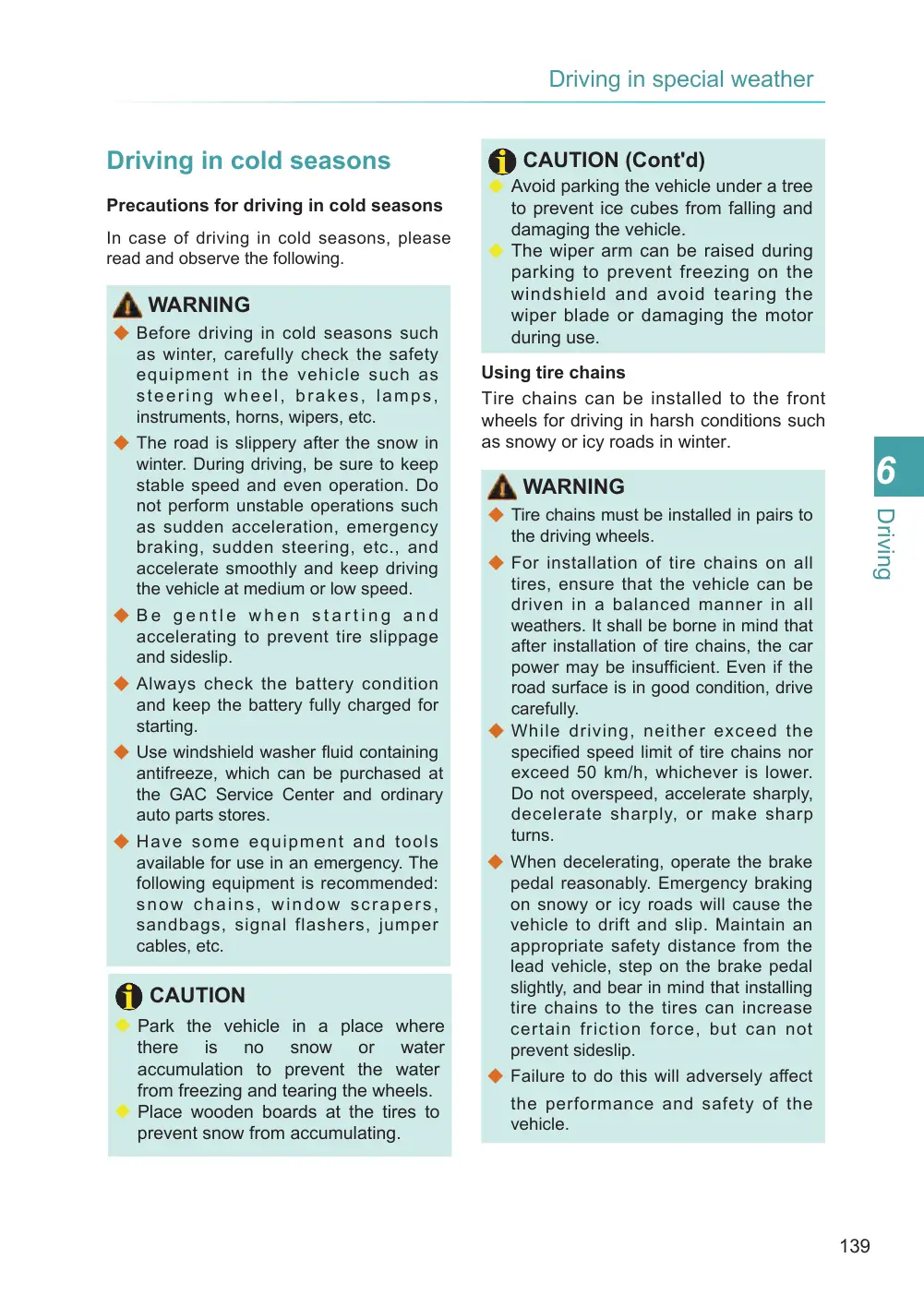
Driving in cold seasons
Precautions for driving in cold seasons
In case of driving in cold seasons, please read and observe the following.
WARNING
◆ Before driving in cold seasons such as winter, carefully check the safety equipment in the vehicle such as steering wheel, brakes, lamps, instruments, horns, wipers, etc. ◆ The road is slippery after the snow in winter. During driving, be sure to keep stable speed and even operation. Do not perform unstable operations such as sudden acceleration, emergency braking, sudden steering, etc., and accelerate smoothly and keep driving the vehicle at medium or low speed. ◆ Be gentle when starting and accelerating to prevent tire slippage and sideslip. ◆ Always check the battery condition and keep the battery fully charged for starting. ◆ Use windshield washer fluid containing antifreeze, which can be purchased at the GAC Service Center and ordinary auto parts stores. ◆ Have some equipment and tools available for use in an emergency. The following equipment is recommended: snow chains, window scrapers, sandbags, signal flashers, jumper cables, etc.
CAUTION
◆ Park the vehicle in a place where there is no snow or water accumulation to prevent the water from freezing and tearing the wheels. ◆ Place wooden boards at the tires to prevent snow from accumulating.
CAUTION (Cont'd)
◆ Avoid parking the vehicle under a tree to prevent ice cubes from falling and damaging the vehicle. ◆ The wiper arm can be raised during parking to prevent freezing on the windshield and avoid tearing the wiper blade or damaging the motor during use.
Using tire chains Tire chains can be installed to the front wheels for driving in harsh conditions such as snowy or icy roads in winter.
WARNING
◆ Tire chains must be installed in pairs to the driving wheels. ◆ For installation of tire chains on all tires, ensure that the vehicle can be driven in a balanced manner in all weathers. It shall be borne in mind that after installation of tire chains, the car power may be insufficient. Even if the road surface is in good condition, drive carefully. ◆ While driving, neither exceed the specified speed limit of tire chains nor exceed 50 km/h, whichever is lower. Do not overspeed, accelerate sharply, decelerate sharply, or make sharp turns.
◆ When decelerating, operate the brake pedal reasonably. Emergency braking on snowy or icy roads will cause the vehicle to drift and slip. Maintain an appropriate safety distance from the lead vehicle, step on the brake pedal slightly, and bear in mind that installing tire chains to the tires can increase certain friction force, but can not prevent sideslip. ◆ Failure to do this will adversely affect
the performance and safety of the vehicle.
Page 140
CAUTION
◆ Do not use tire chains on dry ground. After driving to snow-free roads, remove tire chains.
NOTE
◆ Various countries and regions have different regulations on tire chains. Before assembling tire chains, be familiar with the local laws and regulations.