Blind spot detection
Text of these pages
Page 114
Blind spot detection
102
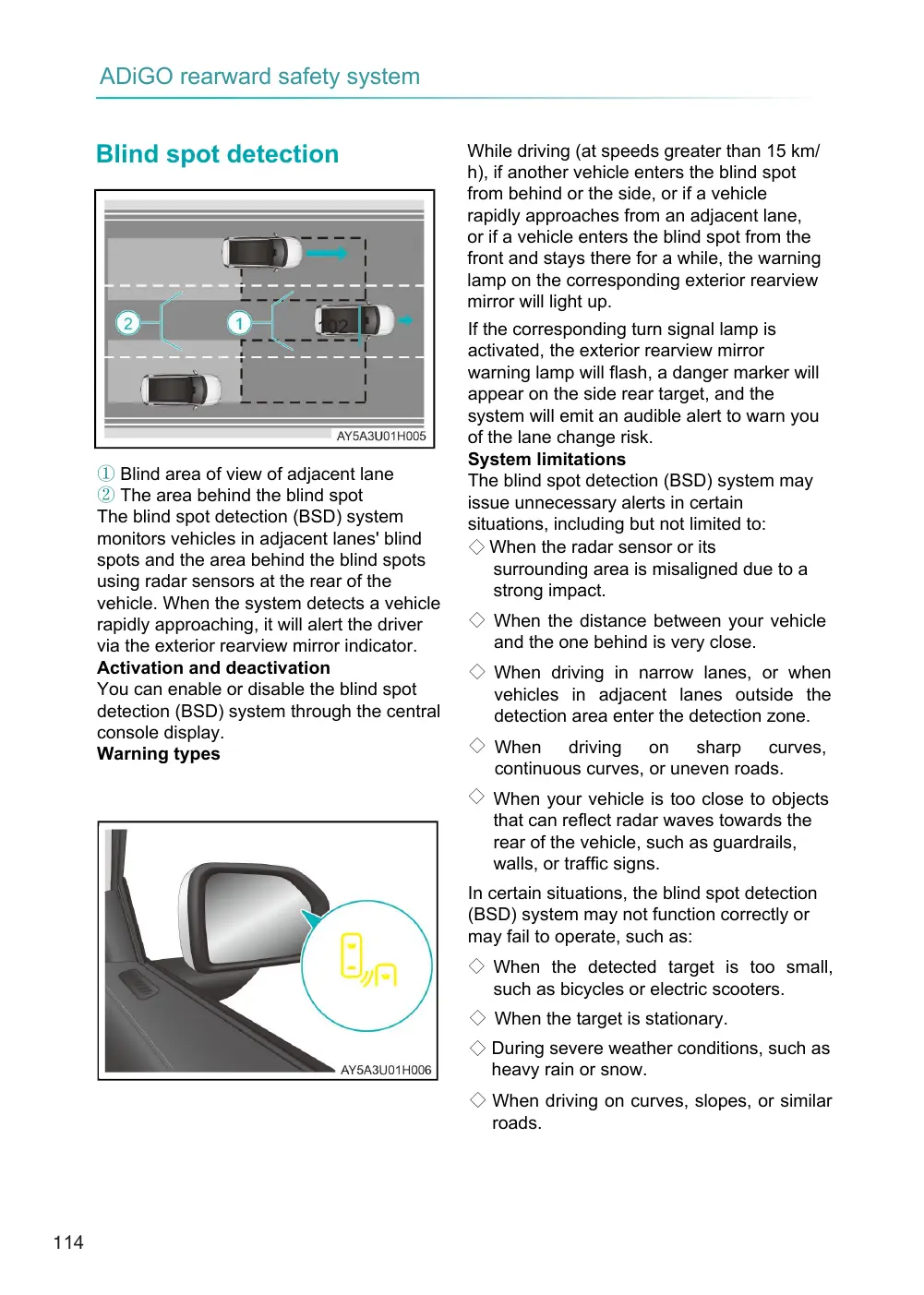
① Blind area of view of adjacent lane ② The area behind the blind spot The blind spot detection (BSD) system monitors vehicles in adjacent lanes' blind spots and the area behind the blind spots using radar sensors at the rear of the vehicle. When the system detects a vehicle rapidly approaching, it will alert the driver via the exterior rearview mirror indicator. Activation and deactivation You can enable or disable the blind spot detection (BSD) system through the central console display. Warning types
While driving (at speeds greater than 15 km/ h), if another vehicle enters the blind spot from behind or the side, or if a vehicle rapidly approaches from an adjacent lane, or if a vehicle enters the blind spot from the front and stays there for a while, the warning lamp on the corresponding exterior rearview mirror will light up.
If the corresponding turn signal lamp is activated, the exterior rearview mirror warning lamp will flash, a danger marker will appear on the side rear target, and the system will emit an audible alert to warn you of the lane change risk. System limitations The blind spot detection (BSD) system may issue unnecessary alerts in certain situations, including but not limited to: ◇ When the radar sensor or its surrounding area is misaligned due to a strong impact.
◇ When the distance between your vehicle and the one behind is very close.
◇ When driving in narrow lanes, or when vehicles in adjacent lanes outside the detection area enter the detection zone.
◇ When driving on sharp curves, continuous curves, or uneven roads.
◇ When your vehicle is too close to objects that can reflect radar waves towards the rear of the vehicle, such as guardrails, walls, or traffic signs.
In certain situations, the blind spot detection (BSD) system may not function correctly or may fail to operate, such as:
◇ When the detected target is too small, such as bicycles or electric scooters.
◇ When the target is stationary.
◇ During severe weather conditions, such as heavy rain or snow.
◇ When driving on curves, slopes, or similar roads.
Page 115
WARNING
◆ The blind spot monitoring (BSD) system is intended to assis driver but may not be applicable in all situations. ◆ For safety, the driver should not rely entirely on the blind spot monitoring (BSD) system and must use the interior rearview mirror and both exterior rearview mirrors correctly.
CAUTION
◆ Ensure that the area around the rear bumper sensors is not covered by ice, snow, or other objects. If sensors are obstructed, the system's performance may be reduced.
◆ The system will automatically return to normal operation when:
A vehicle on the obstructed side is re-detected. - Turn off the power supply in the vehicle and restart it.
NOTE
◆ When the vehicle overtakes another vehicle ahead at a very high speed, the alarm will not be activated for the vehicle in the blind spot as the time that the vehicle stays in the blind spot is too short. ◆ The false alarm, if triggered, just lasts for a short time and can be corrected automatically.
◆ The false alarm, if triggered, just lasts for a short time and can be corrected automatically.
Door open warning
After parking, the vehicle monitors the area behind it. If a vehicle or pedestrian approaches when the driver and passengers open the door, the system will issue an alert to warn of potential collisions with vehicles or pedestrians.
Activation and deactivation
You can enable or disable the door open warning system via the central console display. Warning types
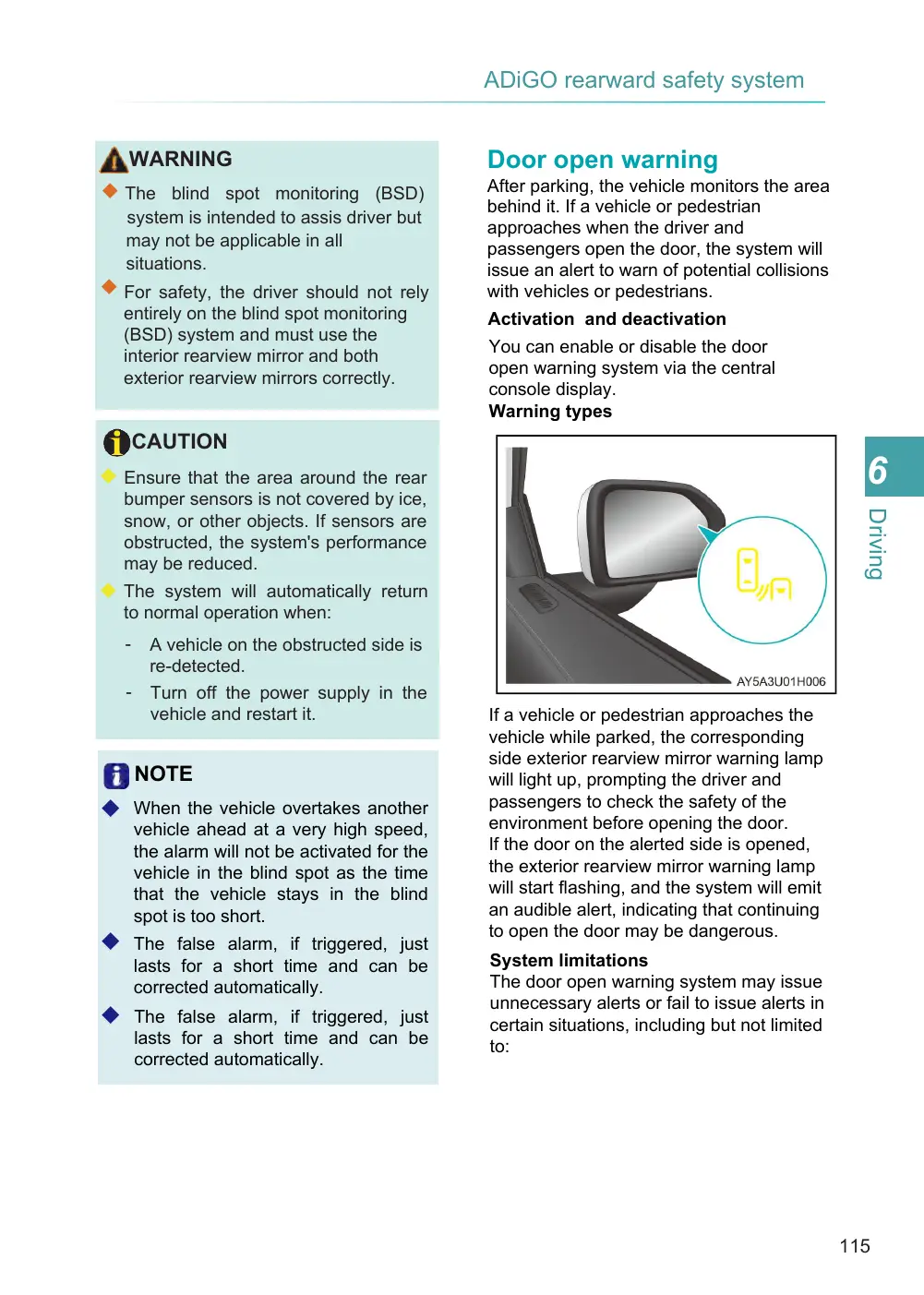
If a vehicle or pedestrian approaches the vehicle while parked, the corresponding side exterior rearview mirror warning lamp will light up, prompting the driver and passengers to check the safety of the environment before opening the door. If the door on the alerted side is opened, the exterior rearview mirror warning lamp will start flashing, and the system will emit an audible alert, indicating that continuing to open the door may be dangerous.
System limitations The door open warning system may issue unnecessary alerts or fail to issue alerts in certain situations, including but not limited to: